AI-generated content has become a core part of modern SEO workflows, helping publishers produce more content in less time. However, publishing AI-written articles without proper review can lead to robotic language, factual errors, and reduced reader trust. That's why many editorial teams now rely on an AI content checker to verify quality before hitting publish.
In this guide, you'll learn how professional publishers use an AI generated content checker within their editorial workflow to review AI-assisted content, improve quality, and maintain high publishing standards.
In this article
- Why SEO Teams Need an AI Content Checker
- Does Google Allow AI-Generated Content?
- What Does an AI Content Checker Actually Check?
- A Typical Publisher Workflow Before Publishing AI Content
- AI Content Checker vs. Manual Editorial Review
- Common Mistakes Publishers Make
- Best Practices for Using AI Content Checkers
- How Humbot Fits into an SEO Content Workflow
Why SEO Teams Need an AI Content Checker
Publishing unvetted generative text introduces serious performance risks for modern search strategies. Primary dangers of unreviewed AI content include:
- Lack of Information Gain: AI synthesizes existing web consensus, producing generic content that offers no unique value or new insights.
- Hallucinations & Factual Errors: Generative models frequently state plausible-sounding false data with absolute confidence.
- Repetitive & Robotic Phrasing: Overused transition words and uniform sentence lengths decrease reader engagement and spike bounce rates.
- Brand Voice Dilution: Raw AI drafts lack personality, brand nuance, and real-world editorial flair.
An AI generated content checker serves as an essential diagnostic tool, flagging machine-like patterns so editors know exactly where human intervention is required before hitting publish.
Does Google Allow AI-Generated Content?
Google's official stance makes it clear: the search engine focuses entirely on content quality rather than how content is produced. According to Google Search's guidance about AI-generated content, Google rewards helpful, original, people-first content regardless of whether it is written by humans or generated by automation.
However, using AI primarily to manipulate search rankings directly violates Google's search spam policies. To align with Google's E-E-A-T (Experience, Expertise, Authoritativeness, Trustworthiness) standards, publishers must remember that AI cannot offer authentic first-hand experience. An AI checker highlights generic sections so editors can inject proprietary data, unique quotes, and real testing.
What Does an AI Content Checker Actually Check?
Unlike plagiarism scanners that match text against existing databases, an AI generated content checker evaluates language probability and structural patterns using specific linguistic metrics:
- Perplexity: Measures text randomness and vocabulary predictability.
- Burstiness: Analyzes variations in sentence length and structure.
- Token Prediction: Evaluates how closely word choices follow standard large language model outputs.
While a content AI checker can effectively flag repetitive cadence and predict machine-like phrasing, it cannot verify factual accuracy, measure topical helpfulness, or understand brand tone. It serves purely as a statistical diagnostic tool, helping editors quickly pinpoint generic passages that require human polishing and real-world expertise before publication.
A Typical Publisher Workflow Before Publishing AI Content
Publishing high-ranking, trustworthy articles requires integrating automated quality checks directly into your editorial pipeline. Here is the visual step-by-step editorial pipeline used by modern web publishers:
Draft Generation: Create the initial outline and text using tools like ChatGPT, Claude, or Gemini.
AI Content Checker Scan: Perform a front-loaded risk assessment to catch robotic syntax before spending editing hours.
Humanizing & Structural Rewrite: Restructure flagged sections to eliminate monotonous cadence and improve flow.
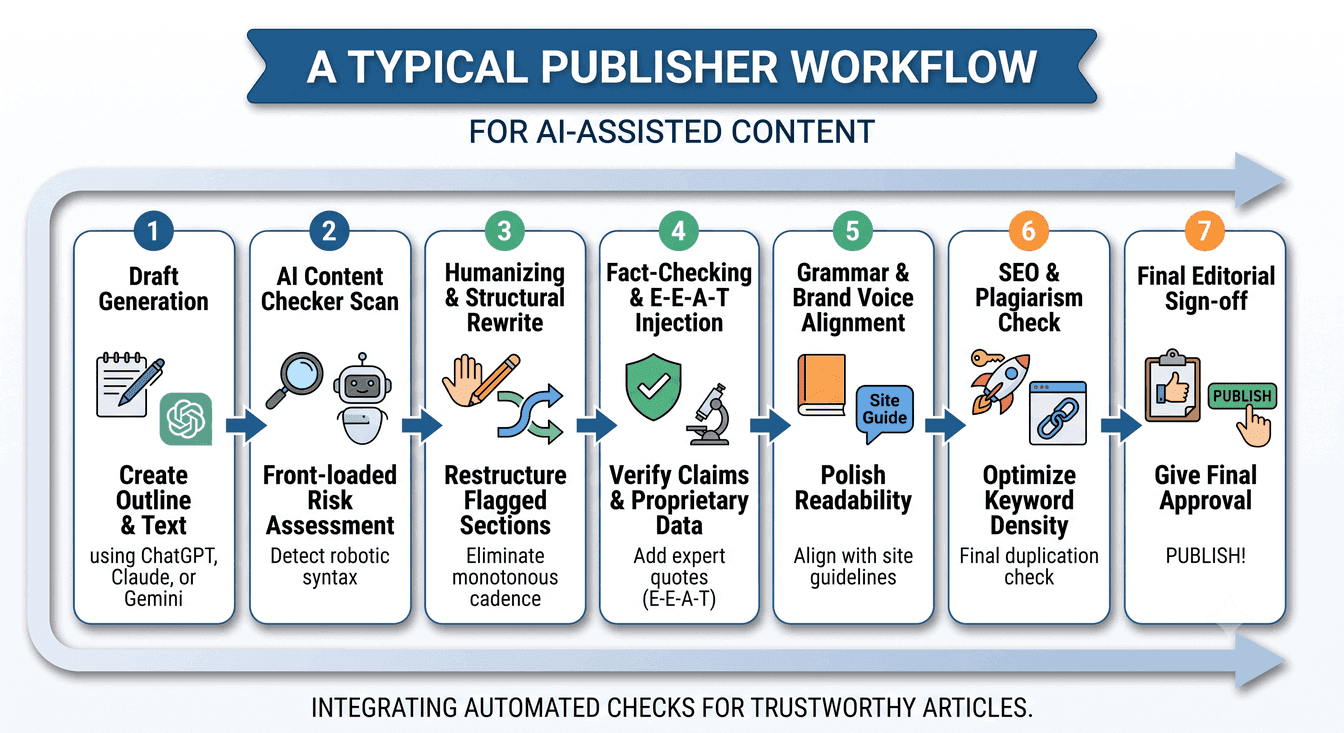
Fact-Checking & E-E-A-T Injection: Verify all claims, inject proprietary data, and add authentic expert quotes.
Grammar & Brand Voice Alignment: Polish readability while aligning tone with site guidelines.
SEO & Plagiarism Check: Optimize keyword density and run a final duplication check.
Final Editorial Sign-off: Give final approval and publish.
Best AI Content Checker Tools for SEO Teams
Humbot AI Checker ⭐ (Best Integrated All-in-One Solution)
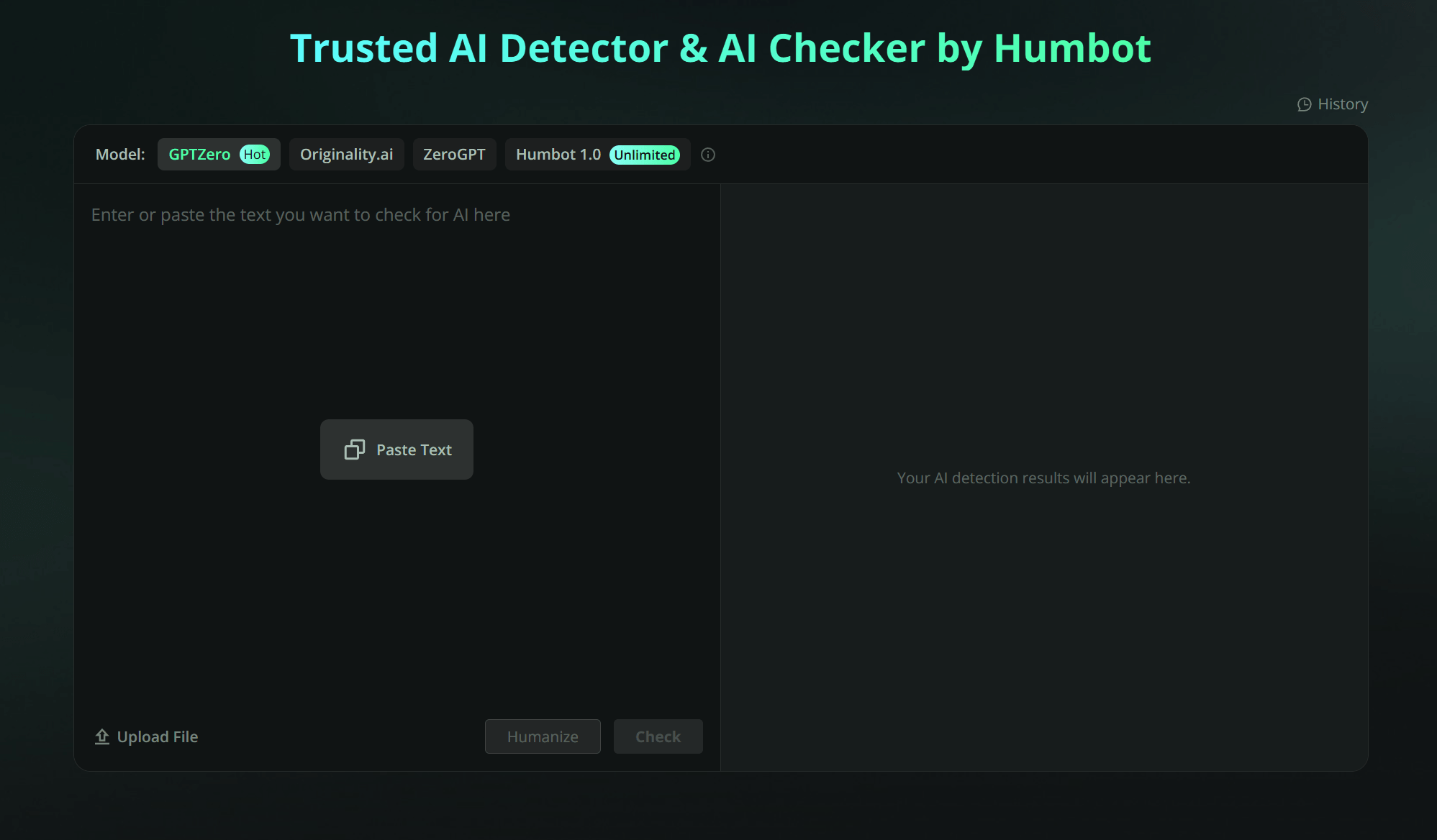
Humbot stands apart as a dual-action platform that not only detects AI writing with high accuracy but also provides instant, seamless humanization tools to rewrite flagged passages in a single workspace. By combining multi-engine detection with contextual rewriting, it allows editorial teams to diagnose and fix robotic syntax without switching tools.
Key Features of Humbot
- Multi-detector scan aggregator for comprehensive detection coverage.
- 1-click contextual AI humanizer to transform flagged text instantly.
- Integrated plagiarism detection to ensure complete content originality.
Pros
- All-in-one check and rewrite workflow.
- Preserves original meaning accurately.
- Aggregates scans across multiple engines.
Cons
- Account sign-in required for batch files.
Best For
Content teams and SEO agencies wanting a single, unified workspace to check, refine, and fix AI content instantly.
Originality.ai
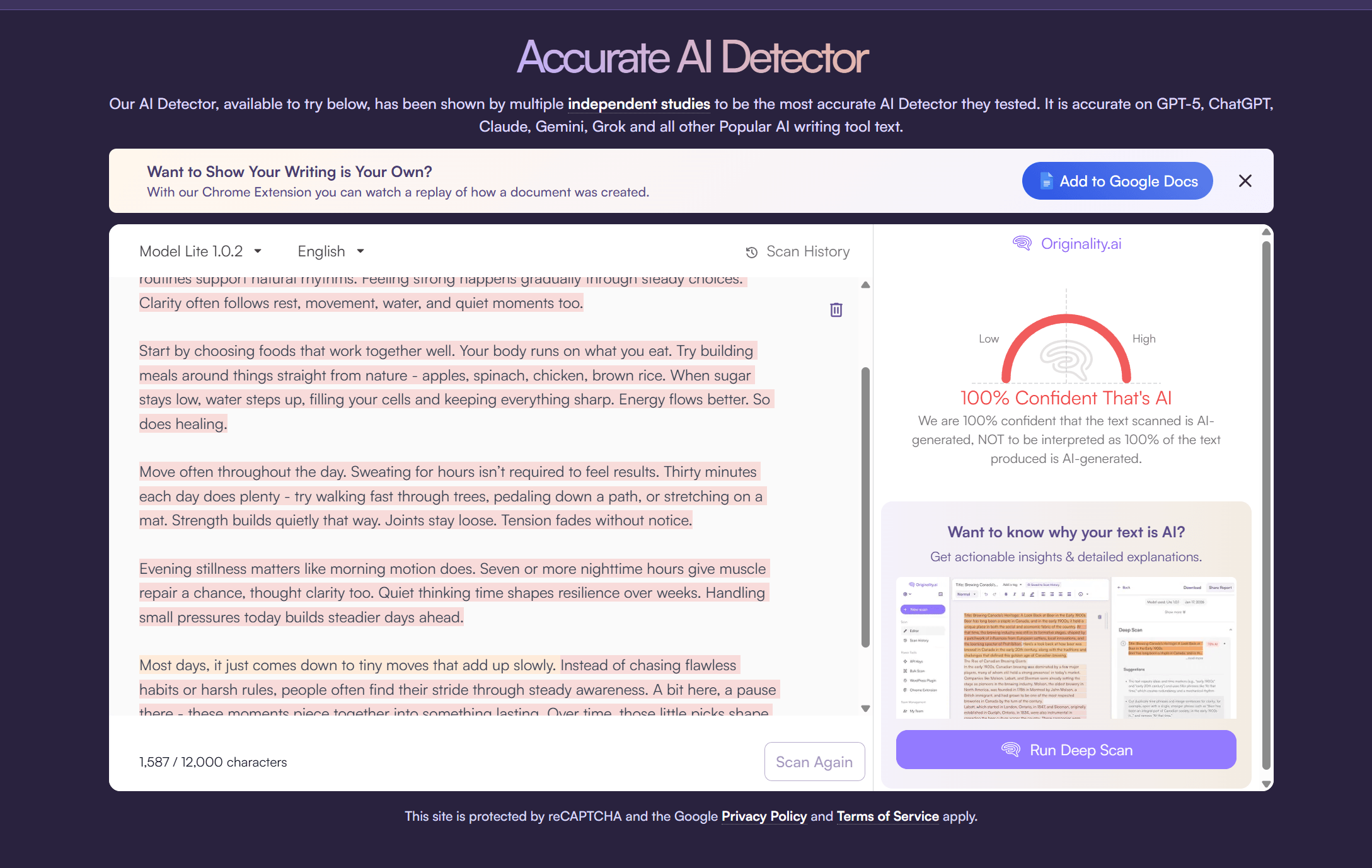
A specialized detection tool tailored for web publishers and agencies managing large freelance writer teams. Originality.ai focuses on high-sensitivity AI detection along with site-wide audit capabilities, making it a common choice for enterprise content governance.
Key Features of Originality.ai
- Team workspace management and multi-user access controls.
- Full domain and site-wide content crawling capabilities.
- Strict AI detection algorithms tuned for modern LLM outputs.
Pros
- Strong team and client management features.
- Supports site-wide domain scanning.
- High sensitivity for modern AI text.
Cons
- Higher false-positive rate on structured human writing.
- Credit-based paid model only.
Best For
Large agency owners and publishers auditing third-party client deliverables and freelance submissions.
GPTZero
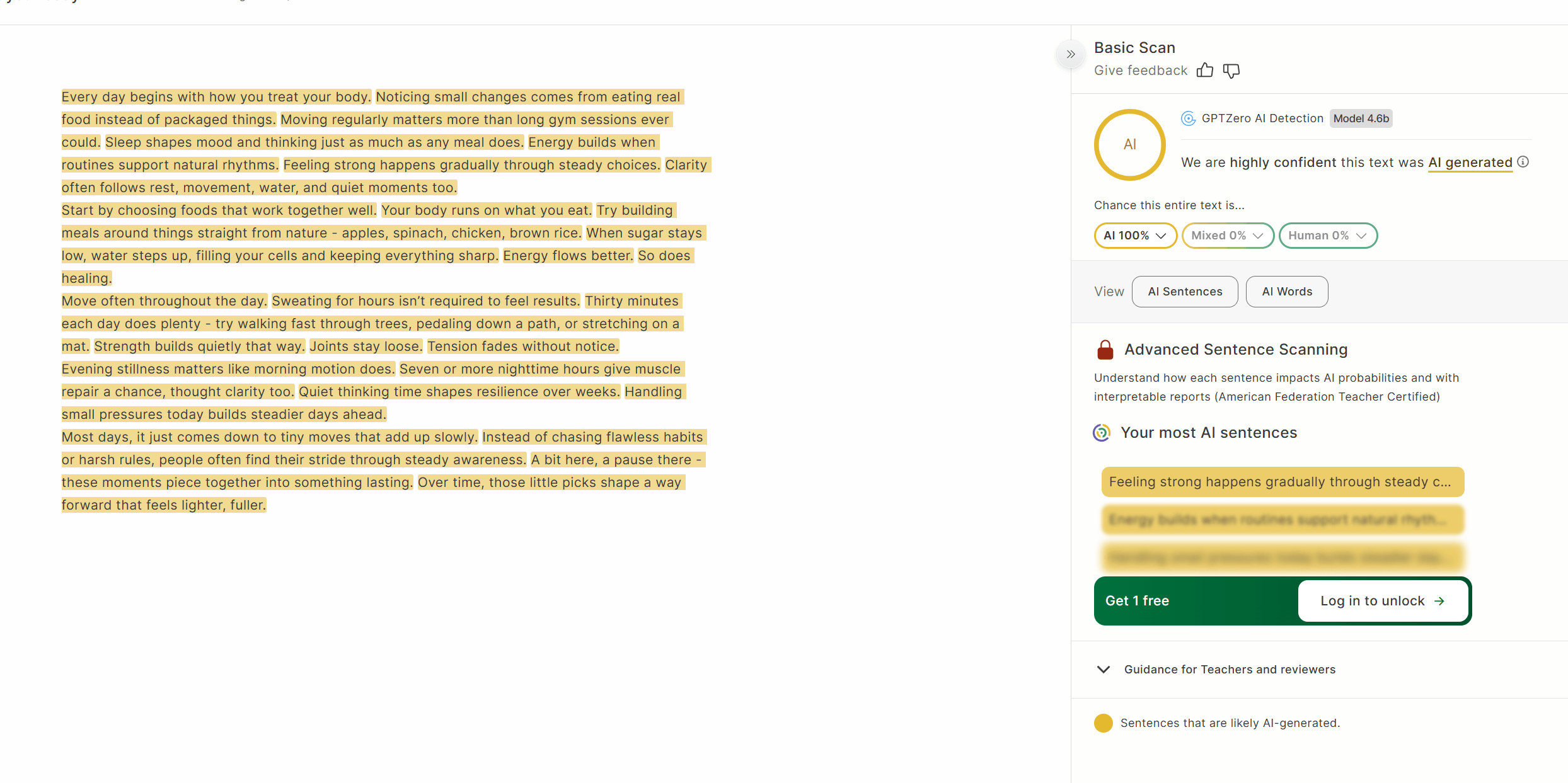
Built originally for academic environments, GPTZero offers clear visual sentence-by-sentence perplexity breakdowns. It provides granular insight into why specific sentences are flagged, helping editors pinpoint statistical predictability in their drafts.
Key Features of GPTZero
- Color-coded sentence probability and perplexity highlighting.
- Deep statistical graphs analyzing burstiness and randomness.
- Detailed document scanning and probability scoring.
Pros
- Clear sentence-level visual breakdowns.
- In-depth perplexity and burstiness metrics.
- Color-coded probability scores.
Cons
- No built-in rewriting or humanizing tools.
Best For
Editors looking for precise, sentence-level statistical breakdowns to guide manual rewrites.
Copyleaks
An enterprise-focused security and detection suite offering both plagiarism and multi-language AI scanning. Copyleaks is engineered for large-scale operations that require API access, code analysis, and seamless LMS integrations.
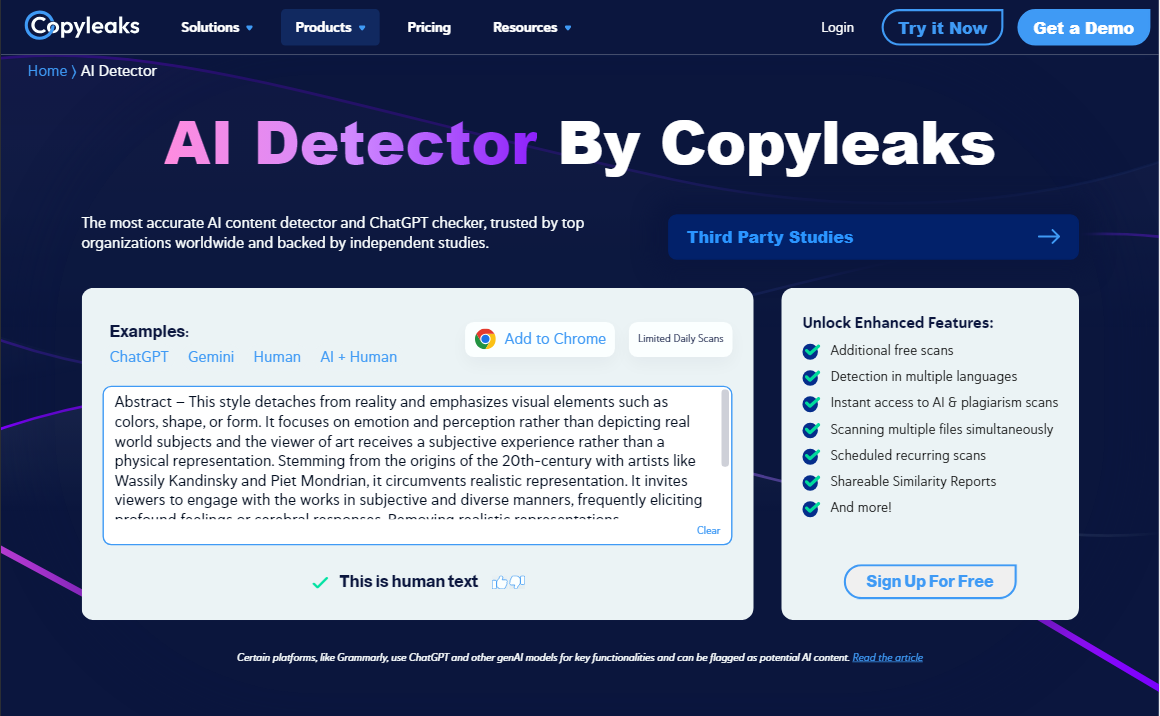
Key Features of Copyleaks
- Enterprise API integrations and Learning Management System (LMS) support.
- Source code and multi-language AI text detection.
- Combined AI scanning and plagiarism cross-referencing.
Pros
- Robust API and enterprise platform integrations.
- Supports multi-language and code scanning.
- Combines AI detection with plagiarism checks.
Cons
- Complex interface for small blogging teams.
Best For
Large enterprise platforms and web networks requiring API-level content verification and security compliance.
AI Content Checker vs. Manual Editorial Review
| Editorial Task | AI Content Checker | Human Editor |
|---|---|---|
| Detect Machine Syntax & Uniform Cadence | ✅ Instant & Automated | ❌ Slow & Subjective |
| Verify Fact Accuracy & Dates | ❌ Cannot Verify | ✅ Essential |
| Inject First-Hand E-E-A-T Experience | ❌ Impossible | ✅ Essential |
| Assess Brand Voice & Audience Intent | ❌ Limited | ✅ Essential |
| Final Publishing Approval | ❌ Diagnostic Tool Only | ✅ Final Authority |
The highest-ranking publishers use checkers as diagnostic tools while relying on human editors for judgment and value addition.
Common Mistakes Publishers Make
When integrating AI into editorial workflows, publishers often fall into traps that undermine content performance and credibility:
- Publishing without review: Releasing raw AI text directly without editorial oversight leads to generic, low-value articles.
- Relying Solely on a Score: Treating an AI score as a absolute pass/fail metric rather than reading the text for actual value.
- Ignoring factual accuracy: Assuming AI checkers verify facts allows hallucinations and false statements to slip through.
- Optimizing only for AI scores: Discarding natural, high-quality phrasing just to achieve a zero-percent AI score damages readability.
- Skipping human editing: Omitting human editors eliminates critical brand voice alignment, nuance, and original E-E-A-T insights.
Best Practices for Using AI Content Checkers
To get the most out of an AI content checker without compromising efficiency or quality, follow this essential editorial checklist:
-
Check After Final Draft
Run scans only after major structural edits are complete to avoid re-checking moving text.
-
Use Multiple Detectors
Cross-reference scores across different engines to reduce reliance on a single algorithm's false positives.
-
Review Highlighted Sections
Focus on specific flagged paragraphs rather than obsessing over an overall percentage score.
-
Rewrite Naturally
Restructure stiff transitions and vary sentence lengths to eliminate repetitive machine-like cadence.
-
Verify Facts
Independently double-check all stats, dates, and claims, as detection tools do not perform fact-checking.
-
Run Plagiarism Checks
Perform a duplication scan alongside your AI audit to ensure total original value.
-
Final Human Review
Do a final read-aloud to ensure the polished article sounds natural and aligns with your brand voice.
How Humbot Fits into an SEO Content Workflow
Rather than acting merely as a standalone detection scanner, Humbot provides an all-in-one editorial ecosystem designed to streamline every stage of content production:
- Research: Use the AI Summarizer to digest complex sources and gather key insights quickly.
- Drafting: Generate your initial article structure using ChatGPT, Claude, or Gemini.
- Rewriting: Pass raw drafts through the AI Humanizer to eliminate stiff, machine-like cadence.
- Checking: Run instant risk scans with the AI Checker to pinpoint remaining detection signals.
- Polishing: Refine overall sentence flow and mechanics using the Grammar Checker.
- Verification: Execute a final scan with the Plagiarism Checker to ensure total original value before you publish.
Connecting these tools into a unified pipeline delivers immediate benefits for publishing teams: faster editorial workflows, enhanced readability, reduced AI detection signals, and consistently higher content quality. By uniting detection with instant remediation, Humbot allows SEO teams to scale output without compromising standards.
FAQs About AI Content Checkers for SEO
1. publishers use AI content checkers?
Yes. Professional publishers use AI checkers as an essential initial quality gate. They identify robotic language patterns, helping editorial teams spot sections that require human polishing, fact-checking, and brand alignment before publication.
2. Can Google detect AI-generated content?
Google uses advanced natural language processing systems to recognize repetitive, low-quality AI text. However, Google targets unoriginal, spammy content rather than penalizing the use of AI tools themselves.
3. Is an AI content checker enough before publishing?
No. AI checkers only evaluate linguistic and statistical probabilities. They cannot verify factual accuracy, assess brand tone, or inject first-hand E-E-A-T experience, making human editorial review mandatory before going live.
4. What is the best AI content checker for SEO?
Humbot AI Checker is ideal for SEO teams because it combines accurate multi-engine detection with an integrated AI Humanizer, allowing editors to catch and fix robotic text within a single workspace.
5. Are free AI content checkers accurate?
Free AI checkers reliably catch basic, highly repetitive LLM patterns. However, premium platforms offer deeper diagnostic algorithms that minimize false positives on technical human writing and support larger document uploads.
6. Can AI content checkers improve rankings?
Indirectly, yes. By flagging rigid, monotonous writing, an AI checker prompts editors to vary sentence structures, eliminate hallucinations, and add original value, improving overall engagement and search rankings.
Conclusion
AI content is now standard in SEO workflows, but successful publishers never rely on automation alone. The best results come from combining AI efficiency with strict human oversight and quality control.
While a reliable AI content checker flags machine like patterns, peak performance requires a complete editorial process. For teams aiming to scale content production without sacrificing quality, Humbot combines accurate detection with writing and humanization tools, helping your editorial team produce natural, high ranking content with absolute confidence.
🛡️100% Data Privacy • 🚀 Instant Access